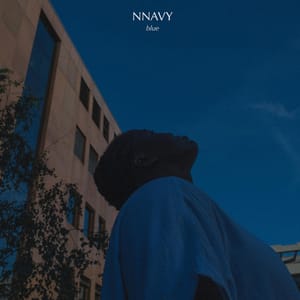
NNAVY Blue (2020)
Few colors have experienced such shifting significance in Western art history as blue. In antiquity, blue played only a minor role, as it was simply difficult to produce. In the Middle Ages, with the discovery of ultramarine extracted from lapis lazuli, blue gained new value. The precious pigment, at times more expensive than gold, was reserved for the robes of the Virgin Mary. This fundamentally changed its symbolism: blue became the color of heaven, of fidelity and of spiritual purity.
The development of synthetic pigments in the 18th and 19th centuries, such as Prussian blue and cobalt blue, finally made the color more accessible. Artists could use it freely, independent of religious constraints: the new era of blue had begun. In Caspar David Friedrich’s work, it figures as the vastness and infinity of nature; in van Gogh’s, it represents emotional intensity. In Picasso’s famous “Blue Period,” it became a means to express psychological states like melancholy, solitude, reflection.
It goes on and on: Expressionists, especially the circle around Der Blaue Reiter, understood blue as a spiritual color. Vasily Kandinsky saw it as an expression of inner, spiritual states and used it to create compositions that lifted the viewer to an immaterial plane. In the 20th century, Yves Klein pushed this idea further: with his International Klein Blue (IKB), he created monochrome works where blue was no longer just a color, but an experience. Klein described it as an “open window to freedom,” lifting the viewer beyond the physical world.
Which brings us directly to our song of the day, “Blue” by Swiss singer NNAVY, where this promise of freedom and escape slips into sound. Soulful vocals meet a reduced piano, giving each lyric room to breathe. The track feels at once familiar and introspective; it is a space of its own, acoustically shaped, fleeting and elusive, just as the sky and the sea.
Dig Deeper

Derek Jarman’s 1993 film Blue is a profound and experimental meditation on life, death and identity, serving as his final cinematic testament before his passing from AIDS-related illness. The film unfolds over 79 minutes of a single, unchanging blue screen accompanied by a rich auditory landscape. This includes narrations by Jarman himself, Tilda Swinton, Nigel Terry and John Quentin, alongside a score by Simon Fisher Turner, featuring contributions from artists like Brian Eno and Coil.
The film intertwines two narrative threads. One explores Jarman’s personal experience as a gay man grappling with the physical and emotional toll of AIDS in 1990s London. His deteriorating vision, reduced to perceiving only shades of blue, profoundly influenced the film's aesthetic and thematic direction. At the same time, the film personifies the color blue, depicting its adventures and interactions with other colors. The closing moments are poignant, listing the names of friends and lovers lost to AIDS, underscoring the personal and collective grief experienced during the epidemic.
Often shown at art cinema screenings, you can also find it on the streaming platform Salzgeber Club. It truly is a one-of-a-kind experience.
Adding to Your Listening Pleasure This Week:




Start the conversation
Become a paid member of The Rest to gain access to the comments section.